
Types of Building Thermal Insulation in Saudi Arabia
Good insulation reduces heat flow through the envelope, improves comfort and helps cooling operate efficiently. Performance depends on thermal resistance, thickness, continuity, moisture and fire suitability, and installation quality.
What makes insulation effective?
Thermal resistance is governed by conductivity and thickness. Continuous insulation without gaps and thermal bridges performs closest to design; voids around edges and penetrations allow heat flow.
Design should consider vapour movement and condensation risk. The optimal assembly differs between a concrete roof, external wall, metal warehouse and cold room.
Comparing common insulation materials
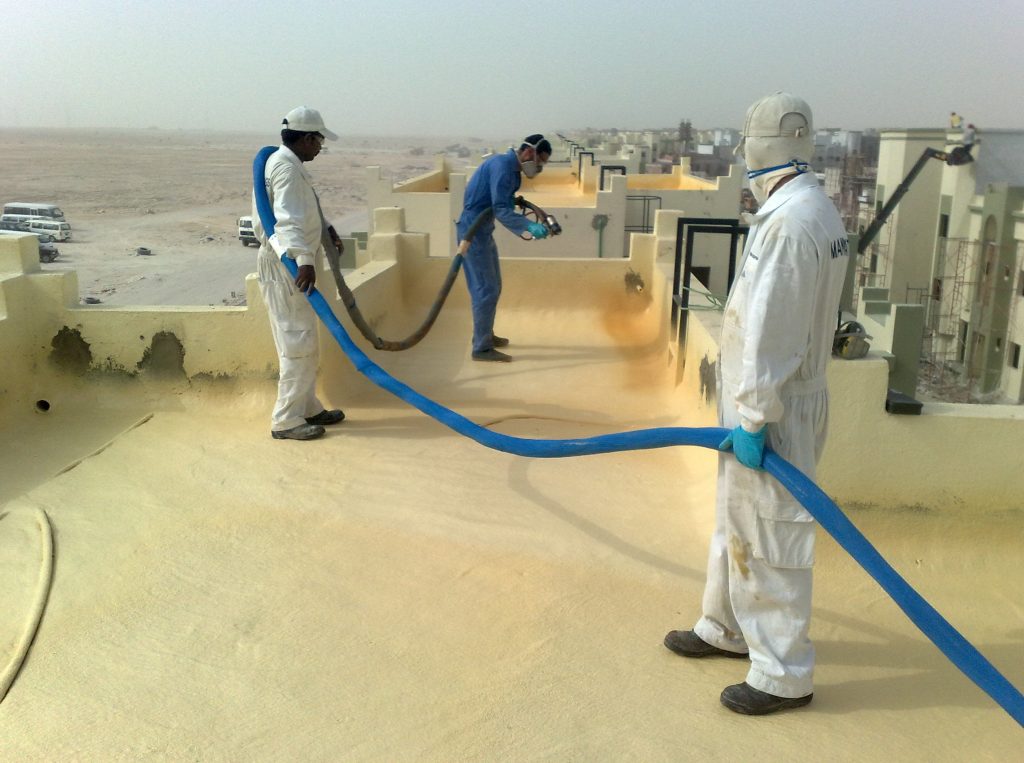
Spray polyurethane foam forms a continuous layer around details and is used on roofs and metal buildings. Its density and thickness need control, plus protection from UV and damage.
XPS has a closed-cell structure with good moisture and compressive resistance. EPS is lightweight and economical, with density selected for loads and use.
Rock wool delivers thermal and acoustic performance with strong fire characteristics for façades, partitions and panels. Approved product data should always be checked.
Selection criteria
Start with required performance, then compare thickness, water absorption, compressive strength, fire classification and dimensional stability. Trafficked roofs prioritise strength; façades give fire behaviour greater weight.
Consider the whole assembly: vapour control, fixings, joints, waterproofing and finish. A premium product installed with gaps can perform worse than an appropriate material in a designed system.
- Thermal resistance and thickness
- Water and moisture exposure
- Loads and compressive strength
- Fire and acoustic requirements
- Compatibility with finishes
Mistakes that reduce performance
Common mistakes include board gaps, compressed material, untreated thermal bridges and insufficient thickness. Trapped moisture or missing vapour control can cause condensation.
Inspect continuity before covering, record thickness and repair damage. Early coordination with services reduces later penetrations through the thermal layer.
A better decision starts with the building
Insulation should not be selected from price alone. Its position in the envelope and interaction with water, vapour, fire and loads turn a product into a successful system.
ISECS delivers integrated thermal insulation from assessment through installation and quality control. Request a consultation to compare suitable options.